The rules at the Trevi Fountain have changed. Since February 2026 there is a €2 fee to enter the close-up area in front of the water. The barriers come down at 10pm and access becomes free again. The basin is drained twice a week for cleaning. The rules around the monument are enforced with fines up to €450.
This is the complete 2026 guide. When to go, what it costs, what is free, what is illegal, and the Roman city preserved a hundred metres away that almost no tourist knows about.
Read this before you go.
Is the Trevi Fountain open 24/7?
Yes and no. The Trevi Fountain itself is visible 24 hours a day from Piazza di Trevi — the square is public space, never closed, never gated. You can see the fountain at 3am if you want to. The water runs all night.
What is not open 24/7 is the new paid close-up viewing area, introduced in February 2026. That section operates from 9am to 10pm daily and costs €2 to enter. Outside those hours the close-up area is closed, but the view from the surrounding square remains free and open at any hour.
The best free view is between 11pm and 6am — the floodlights stay on until late, the crowd disappears, and you get the fountain almost to yourself.
How much does the Trevi Fountain cost in 2026?
On February 2, 2026, Rome officially introduced a €2 entry fee for the close-up viewing area at the Trevi Fountain. This is the area right next to the water — where people traditionally stand to take close photographs and toss their coin.
Here is exactly what changed and what did not.
What is free: You can still see the Trevi Fountain from Piazza di Trevi exactly as before. Standing in the square, watching the fountain, taking photographs from the piazza — no ticket, no barrier, no cost. The fountain is still visible from the surrounding square for free.
What costs €2: Entering the controlled area directly in front of the water. The close-up viewpoint. The spot where you toss the coin over your shoulder.
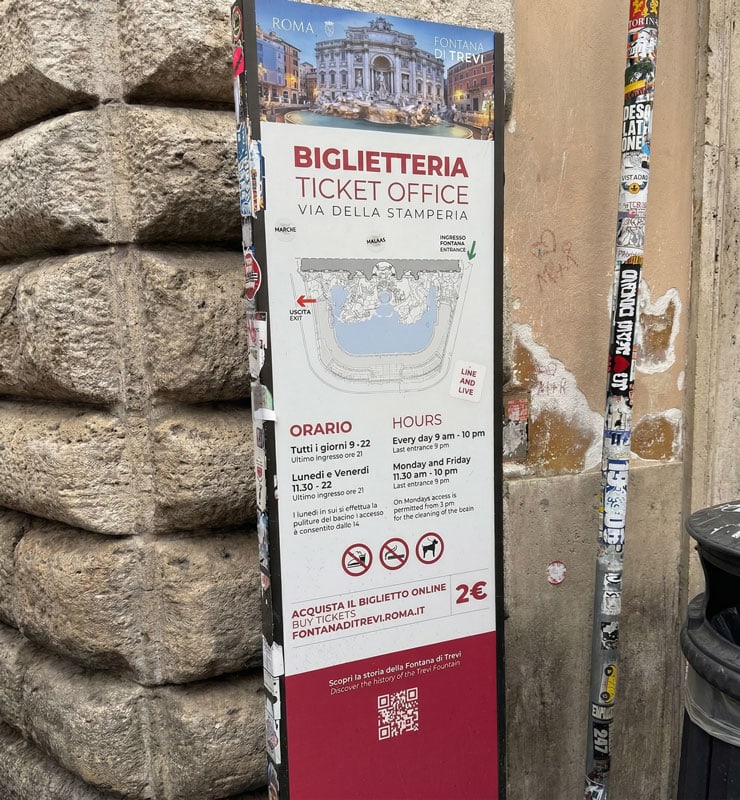
The fee is €2 per person. Payment is on site at the controlled entrance. Card payments are accepted. In busy periods you may scan a QR code and wait briefly for your turn to enter.
Access hours for the paid area: 9am to 10pm daily.
Early morning and late night viewing from the square remains free, as it always has been.
Who can visit the Trevi Fountain for free?
These categories enter the close-up area free of charge:
- Rome residents with valid ID
- Children under 5
- Visitors with disabilities and one companion
Why does the Trevi Fountain now cost €2?
The Trevi Fountain receives tens of thousands of visitors per day in peak season. The square it sits in was designed for a fraction of that number. On a July afternoon it holds four thousand people in a space meant for two hundred.
The €2 system is designed to reduce dangerous overcrowding, protect the monument, and improve the experience for everyone inside the controlled area. Fewer people, more space, less chaos. In practice — and this is the honest assessment — the change has made the close-up experience noticeably better. The people who have been since February say the area in front of the water is calmer than it has been in years.
It is €2. It is worth it.
Should I go to the Trevi Fountain at night?
Here is the part nobody tells you. After 10pm, the ticket booth closes, the staff in blue vests go home, and the barriers around the basin are physically opened. The €2 fee disappears. You can walk straight down the steps to the edge of the water — for free — exactly the way every visitor used to before February 2026.
This is not a loophole. It is how the system works. The €2 controls daytime crowding when 30,000 people pass through in a single day. At night the volume drops, the staff are not paid to stand there, and the city opens it up.
Last entry to the paid daytime route is 9pm. Between 9pm and 10pm the route is being closed down. From 10pm onwards the basin is free again, and remains free until 8am the next morning when the booth reopens.
If your only goal is to stand at the edge of the water, toss a coin, and take a close-up photograph of Oceanus and the tritons, do it after 10pm. You get the same access as the paid daytime visitors. You pay nothing. You also get the fountain at its most cinematic — the floodlights are on, the marble glows, and the crowd is a fraction of what it is at noon.
This is the answer to the question most tourists arrive in Rome without knowing they should be asking.
What are the rules at the Trevi Fountain? Fines explained
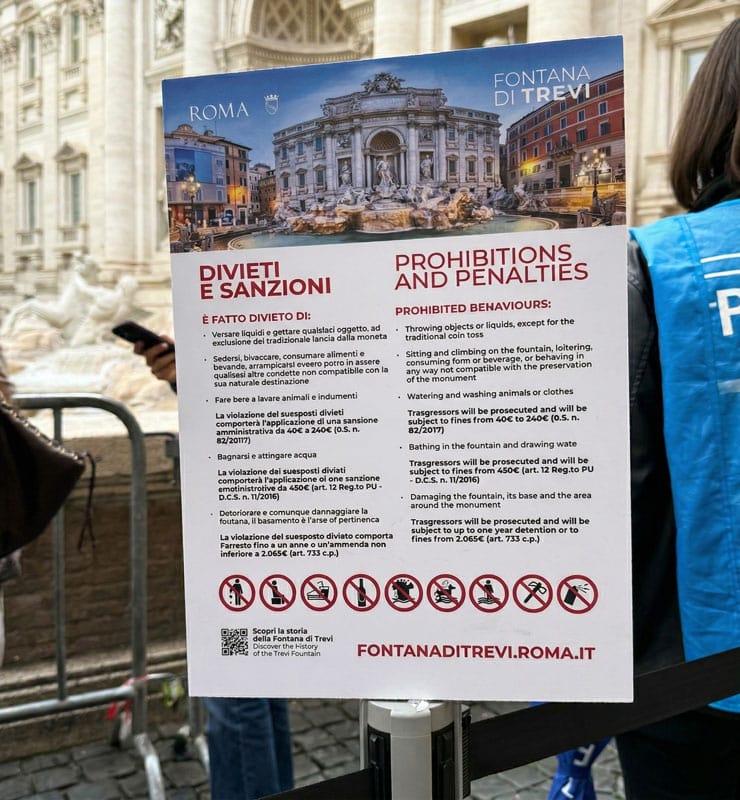
The €2 entry fee is not the only cost you can face at the Trevi Fountain. Rome has specific rules about behaviour at the monument and they are enforced every day, especially in summer.
Sitting on the fountain edge or basin: Illegal. Fine up to €450. Police patrol the area continuously during peak hours. You will see tourists doing this. You will also see them standing up very quickly when an officer appears.
Eating or drinking at the fountain: Illegal. Same fine range. Do not eat while sitting on or directly at the fountain.
Swimming or wading in the water: Illegal. This one carries fines at the higher end of the scale and has resulted in tourists being removed from the country.
Touching the water or putting your feet in: Illegal. Fine up to €450. This includes dipping your hand in, sitting on the edge with your feet in the basin, or filling a bottle. The reason is not just crowd control. Skin oils, sunscreen, and foot dirt damage the travertine stone — the same stone the Colosseum is built from, which absorbs everything it touches. The famous La Dolce Vita scene with Anita Ekberg was filmed in 1960 under conditions that no longer exist. The water is also non-potable. It is recirculated through the system and not safe to drink.
Tossing coins outside the designated area: The coin toss is part of the tradition — one coin tossed over your left shoulder with your right hand means you will return to Rome. But tossing coins into fountains other than the Trevi is illegal and can result in a fine. At the Trevi itself, toss inside the controlled area.
Touching or climbing the sculptures: Illegal. The stonework is 2,600 years of Italian heritage. The fines reflect that.
These rules are not suggestions. The officers are there every day and they are not interested in the fact that you did not know.
Dress code: None. The Trevi Fountain is an outdoor monument with no clothing requirements. Shorts, swimwear, sleeveless tops — all fine. This is different from Roman churches, where shoulders and knees must be covered. If you are combining the Trevi with a visit to St. Peter’s, the Pantheon, or any church on the same day, dress for the church rules and you will be fine everywhere.
What day is the Trevi Fountain empty? Cleaning schedule
This is the mistake nobody warns you about until it is too late.
The Trevi Fountain basin is drained for cleaning and coin collection on Monday and Friday mornings. If you arrive expecting the famous turquoise water and instead find an empty stone basin, this is why.
There is no fixed time that cleaning ends. Some mornings the basin is drained early and refilled by 11am. Some mornings it runs later. The schedule is not published in advance with precision.
The rule is simple: do not make the Trevi Fountain your first stop on a Monday or Friday morning. If those are your only available days, go in the afternoon to be safe.
Beyond the twice-weekly cleaning, the fountain can also be temporarily closed or partially obstructed for restoration work, papal events, official city ceremonies, and the BNL light show setup in late April. These closures are rare and short. The basin is never fenced off to viewing — even during restoration the surrounding piazza stays open. If you see “Trevi Fountain closed” trending online, it almost always refers to one of the Monday or Friday cleanings, not a longer closure.
If you do arrive and find the basin empty, the area around the fountain is full of free things to see while you wait — there are 10 free attractions in Rome within walking distance, including the Pantheon, Piazza Navona and Sant’Ignazio with its painted ceiling.
What time should I go to the Trevi Fountain?
The time you visit the Trevi Fountain matters more than almost any other decision you make about it.
At noon in July: four thousand people in the square. You see shoulders, phones, and selfie sticks. You do not see the fountain. The noise is constant. The pushing is real. The experience is the opposite of what you came for.
At 6:30am: twenty people in the square. The light is low and warm. The water sounds like water. You can stand at the edge of the controlled area and actually look at what Nicola Salvi built — the triumphal arch, the figures of Oceanus and the tritons, the way the entire palace facade becomes the backdrop for the water. You can think. You can feel the scale of it.
At 11pm: the floodlights turn the marble gold. The crowd drops to a fraction of the daytime numbers. The fountain looks completely different after dark — warmer, more theatrical, the water catching the light in a way the daylight visit does not give you.
The Trevi Fountain is one of the most extraordinary things in Rome. The experience of it depends almost entirely on when you show up.
Go at 6:30am or go after 10pm. Everything in between is the tourist version.
Trevi Fountain live cam: check the crowds before you leave the hotel
There is a 24-hour webcam pointed directly at the Trevi Fountain. It has been running since 2017. It is operated by SkylineWebcams, the largest live cam network in Italy, and the stream is free with no registration.
This is more useful than it sounds. Before you leave your hotel for the fountain, open the cam on your phone. You see in real time exactly how packed the square is right now. If it looks like a concert at the front row, wait two hours. If the basin is half-empty, leave immediately.
The cam is also the easiest way to confirm whether the fountain is drained on a Monday or Friday morning before you walk twenty minutes to find an empty stone basin.
It runs all night. The illumination after dark is genuinely beautiful even through a webcam, which is why this stream has had millions of viewers from people who will never visit Rome in person.
Use it to plan. It costs nothing.
What does throwing 3 coins in the Trevi Fountain mean? The coin toss rules
One coin, tossed over your left shoulder with your right hand, into the Trevi Fountain means you will return to Rome. That is the tradition, traced to the 1954 film Three Coins in the Fountain that made the ritual famous worldwide.
Two coins means you will fall in love in Rome. Three coins means you will marry there.
The coins are collected regularly — this is part of why the fountain is drained on Monday and Friday mornings — and the proceeds go to a Roman charity called Caritas that provides food for people in need. Approximately €3,000 worth of coins is tossed into the basin every day. Over a full year that adds up to around €1.5 million, all of it donated to Caritas to fund food programmes across Rome.
Toss inside the controlled area. Over the left shoulder, right hand. One coin is enough.
Who designed the Trevi Fountain? History and architecture
Most tourists photograph the fountain without knowing what they are seeing. Here is what Nicola Salvi built between 1732 and 1762.
The central figure is Oceanus — god of all water — standing on a shell-shaped chariot drawn by two sea horses. One horse is calm, one is agitated. They represent the two moods of the sea. On either side, tritons guide the horses through the water. The whole composition emerges from a triumphal arch — the facade of Palazzo Poli, which Salvi incorporated into the design so completely that the building and the fountain are inseparable. The water pours from multiple levels and collects in the basin below.
The Trevi Fountain marks the terminal point of the Aqua Virgo — the sixth of ancient Rome’s eleven aqueducts, built in 19 BC by Marcus Agrippa, which still supplies the water to this day.
Stand in front of it for five minutes and actually look at it. Not through your phone. At it.
Is there an underground Trevi Fountain you can visit?
Almost no tourist who visits the Trevi knows that there is a complete archaeological site preserved under the next street.
It is called Vicus Caprarius — also known as the Città dell’Acqua, the City of Water. The entrance is at Vicolo del Puttarello 25, less than a hundred metres from the Trevi Fountain. From the piazza, walk down Via di San Vincenzo. The doorway is on the left.
What is inside is a section of ancient Rome, nine metres below modern street level. A Roman insula — a multi-storey apartment building — built in the 1st century AD, expanded into a luxury domus in the 4th century with marble facing and mosaic floors. Beside it, the Aqua Virgo aqueduct itself: the ancient channel that has carried water from the Salone springs into central Rome since 19 BC and still supplies the Trevi Fountain today. You can hear the water moving.
The site was discovered in 1999 during the renovation of a cinema. The excavation took four years. It opened to the public in 2003.
Practical information:
- Address: Vicolo del Puttarello 25, 00187 Roma
- Hours: Tuesday to Sunday, 11am to 5pm (last admission 4:30pm). Closed Mondays.
- Tickets: €4 adults / €2.50 reduced (students, EU citizens 18–25) / €1 children 14–17 / free under 14
- Booking: mandatory at weekends, recommended on weekdays. Phone or WhatsApp +39 339 7786192
The visit takes 30 to 45 minutes. The temperature underground stays around 15°C, so bring a layer even in August.
This is one of the rare places in Rome where you can stand directly inside an ancient Roman building and a 2,000-year-old aqueduct in the same room. It costs €4. It is a hundred metres from the most photographed monument in Italy. Almost nobody goes.
Is there a Trevi Fountain light show in 2026?
Yes — but only for two weeks each spring, around the Internazionali BNL d’Italia tennis tournament. The 2026 edition ran from 29 April to 10 May, every evening from 9pm to midnight. It is now over. The next edition is expected in late April 2027.
During the show, the entire facade of the Trevi Fountain is transformed by a video mapping projection. Colour washes across the marble. Animated patterns rotate around the central figures. Silhouettes of the tournament’s headline tennis players appear and dissolve. The water and the light interact in a way that makes the fountain look completely different from anything in the photographs.
It is free. You watch it from Piazza di Trevi like everyone else. No ticket, no booking.
The video mapping is tied to the Internazionali BNL d’Italia, the ATP/WTA 1000 tennis tournament running at the Foro Italico from 28 April to 17 May 2026. The Trevi projection is a city of Rome initiative to bring the tournament into the centre. The mapping started on 29 April and runs until 10 May, every night from 21:00 to 24:00. The animation loops on a short cycle, so you see the full sequence multiple times during the three-hour window.
The colours come from the tournament — azzurro and ocra, the blue of Italy and the ochre of clay courts. They wash across Salvi’s marble like a second sea.
The detail that matters: the €2 close-up access fee is enforced from 9am to 10pm. The video mapping starts at 9pm. So between 9pm and 10pm, you still need a €2 ticket to be on the basin steps while the show is running. From 10pm to midnight, the barriers come down and the close-up area becomes free again — and the show is still on. The cleanest free experience is after 10pm. You get the full mapping, the floodlit basin, the thinned crowd, and you pay nothing.
This kind of event runs annually around the BNL tournament — late April through early May. It happened in 2024. It happened in 2025. It is happening now. If your trip falls outside that window, you will not see it.
What you will see, every other night of the year, is the permanent illumination. 100 LED lights installed during the 2015 restoration funded by Fendi. 85 of them underwater, picking out the figures and the rock face. The rest positioned outside the water to highlight the architecture above. ACEA — the Roman water company that also manages the aqueduct supplying the fountain — runs the system. On every night from sunset until late.
That is the default state of the fountain at night. Beautiful, but not a “show.” The mapping is the show. The mapping is temporary. The illumination is permanent. Now you know the difference.
Practical information for 2026
Entry to close-up area: €2 per person, 9am to 10pm daily
Free viewing: from Piazza di Trevi at any time, no charge
Cleaning days: Monday and Friday mornings — basin may be drained
Fines for rule violations: up to €450
Best times to visit: before 7:30am or after 10pm
How to pay: on site at the entrance, card accepted
Who enters free: Rome residents, children under 5, visitors with disabilities and one companion
Coin toss: right hand over left shoulder, inside the controlled area only
One last thing
The Trevi Fountain is worth the early alarm. It is worth the €2. It is worth doing properly rather than rushing through at 2pm in August with four thousand other people and leaving with a photograph of someone else’s shoulder.
Rome built this over thirty years. Nicola Salvi spent his entire career on it and died before it was finished. The water has been running for two thousand years.
Give it more than five minutes. Go at the right time. And actually look at it.
FAQ: Trevi Fountain Rome 2026
How much does it cost to visit the Trevi Fountain in Rome in 2026?
The Trevi Fountain itself is free to view from Piazza di Trevi at any time, day or night. A €2 ticket is required only to enter the close-up basin area between 9am and 10pm (11:30am to 10pm on Mondays and Fridays, when the morning is reserved for cleaning). After 10pm the barriers are open and the basin is free for everyone.
Do I need to book Trevi Fountain Rome 2026 tickets in advance?
No. Tickets are not timed and there is no booking calendar. You can pay €2 on the spot at the controlled entrance, by card or by scanning the QR code posted on site. Skip any third-party reseller — there are no skip-the-line or premium tickets.
Is the Trevi Fountain free to see in 2026?
Yes. The view from the surrounding square is completely free. The €2 fee only applies to the close-up area at the basin level. You can also access the basin for free between 10pm and 8am, when the staff and barriers are gone.
What time does the Trevi Fountain light up?
The fountain’s LED illumination switches on automatically at sunset and stays on until late — around 9pm in summer, closer to 5pm in winter. The lighting system was installed in 2015 during the Fendi-funded restoration: 100 LED lights in total, 85 of them underwater picking out the figures and the rock face, the rest above the water highlighting Palazzo Poli behind. It is run by ACEA, the Roman water company that also manages the aqueduct supplying the fountain. The illumination is permanent and runs every night of the year. The temporary video mapping light show only happens during the BNL tennis tournament in late April and early May.
How many coins are thrown into the Trevi Fountain each year?
Approximately €1.5 million worth of coins are tossed into the fountain every year. They are collected during the Monday and Friday morning cleanings and donated to Caritas, the Catholic charity that runs food programmes for people in need across Rome.
Where is the Trevi Fountain in Rome?
The Trevi Fountain is in the Trevi district of central Rome, at the junction of three streets — which is where the name “Trevi” comes from (tre vie, three roads). The closest metro stop is Barberini on Line A, a seven-minute walk away. The fountain sits between the Pantheon and the Spanish Steps and is easily walkable from both.
Is the Trevi Fountain worth visiting?
Yes — but only if you go at the right time. At noon in July it holds four thousand people in a square designed for two hundred and the experience is the opposite of what you came for. Before 7am or after 10pm, it is one of the most extraordinary monuments in Europe. Timing is the entire decision.
Are you allowed to touch the water in the Trevi Fountain?
No. Touching the water, wading, scooping coins, or putting your hands in the basin is illegal and carries fines starting at €450. The fountain is a national monument, not a public swimming pool. The water is also non-potable — it is recirculated through the system and not safe to drink.
Why are you not allowed to put your feet in the Trevi Fountain?
Because it is a 264-year-old Baroque monument made of travertine stone, and skin oils, sunscreen, and foot dirt damage the surface. Beyond the conservation reason, the fine is up to €450 and enforced by the police who patrol the piazza every hour. The famous La Dolce Vita scene with Anita Ekberg was filmed in 1960 under conditions that no longer apply.
Is there a dress code for the Trevi Fountain?
No. The Trevi Fountain is an outdoor monument with no dress code at all. Shorts, swimwear, sleeveless tops — all fine. This is different from Roman churches, where shoulders and knees must be covered. If you are combining the Trevi with a visit to St. Peter’s or any other church on the same day, dress for the church rules.
What does throwing 3 coins in the Trevi Fountain mean?
One coin tossed over your left shoulder with your right hand means you will return to Rome. Two coins means you will fall in love in Rome. Three coins means you will marry there. The tradition was made famous worldwide by the 1954 film Three Coins in the Fountain. Toss inside the controlled area only — coins thrown from outside can land on other tourists and the city has signalled that patrols may be introduced to stop it.
When is the Trevi Fountain closed for cleaning?
The basin is drained for cleaning and coin collection on Monday and Friday mornings. There is no fixed end time — some weeks it refills by 11am, other weeks closer to noon. The fountain itself is never closed to viewing, but if you arrive during cleaning the basin will be empty stone. Use the live webcam to check before you leave your hotel.
Is the Trevi Fountain open 24/7?
Yes — the Piazza di Trevi is public space and never closes. You can see the fountain at any hour of the day or night. The paid €2 close-up area operates from 9am to 10pm. Outside those hours the close-up area is free to access until 8am the next morning. The fountain water itself runs 24 hours a day.
How old is the Trevi Fountain?
The Trevi Fountain was completed in 1762, which makes it 264 years old in 2026. Construction started in 1732 and lasted thirty years. The architect was Nicola Salvi, who died in 1751 before the project was finished. It was completed by Giuseppe Pannini.
Who designed the Trevi Fountain?
The Trevi Fountain was designed by Nicola Salvi, a Roman architect who won the commission in 1732. The original 1730 design contest organised by Pope Clement XII was won by a Florentine architect, Alessandro Galilei, but Roman public opinion forced a re-vote that went to Salvi. The work was completed by Giuseppe Pannini after Salvi’s death in 1751. An earlier abandoned design by Bernini, from the 1640s, set the orientation of the fountain but was never built.