I live in Italy. Piazzale Michelangelo has the most famous view of Florence — the Duomo, the Arno, the rooftops, the hills behind. It is free, open all day, no ticket, no queue.
Most guides tell you to go for sunset and stop there. There is more to know.
What Piazzale Michelangelo actually is, and what most guides forget to mention
A panoramic terrace on the hill of San Miniato, on the south bank of the Arno. It was built in 1869 by the architect Giuseppe Poggi when Florence was the capital of Italy and the whole left bank was being redeveloped. The plan was for the neoclassical loggia behind the terrace to become a museum housing copies of every Michelangelo work in the city. The museum was never built. The loggia became a restaurant. The square became the most photographed viewpoint in Florence.
It is free. It is open 24 hours. There is no ticket and no booking.
What it is not: a quiet place. From April to October the piazzale is busy. Tour buses unload directly into the square. Vendors sell souvenirs and counterfeit bags from folding tables. The restaurants behind the loggia charge tourist prices for what they serve. None of this affects the view. It does affect what you walk into.
Is it worth visiting. Yes. The view is worth the climb every time. The rest of this post is how to make the visit better than ten minutes at the railing.
When to visit Piazzale Michelangelo: sunset is the obvious answer and not the only one
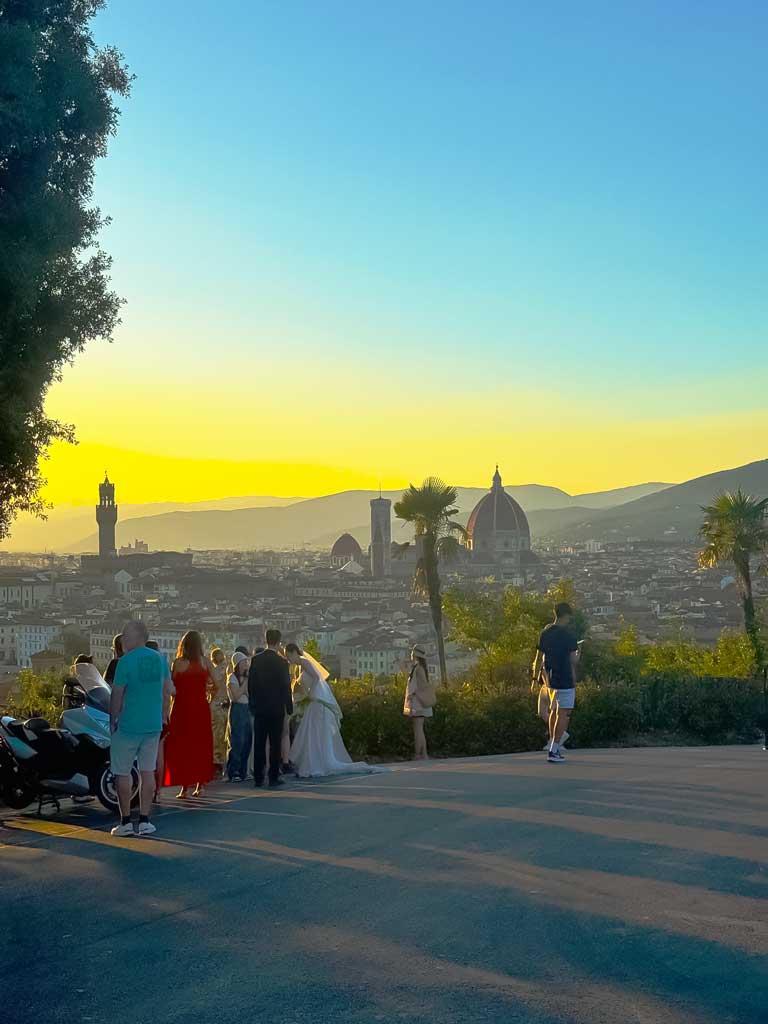
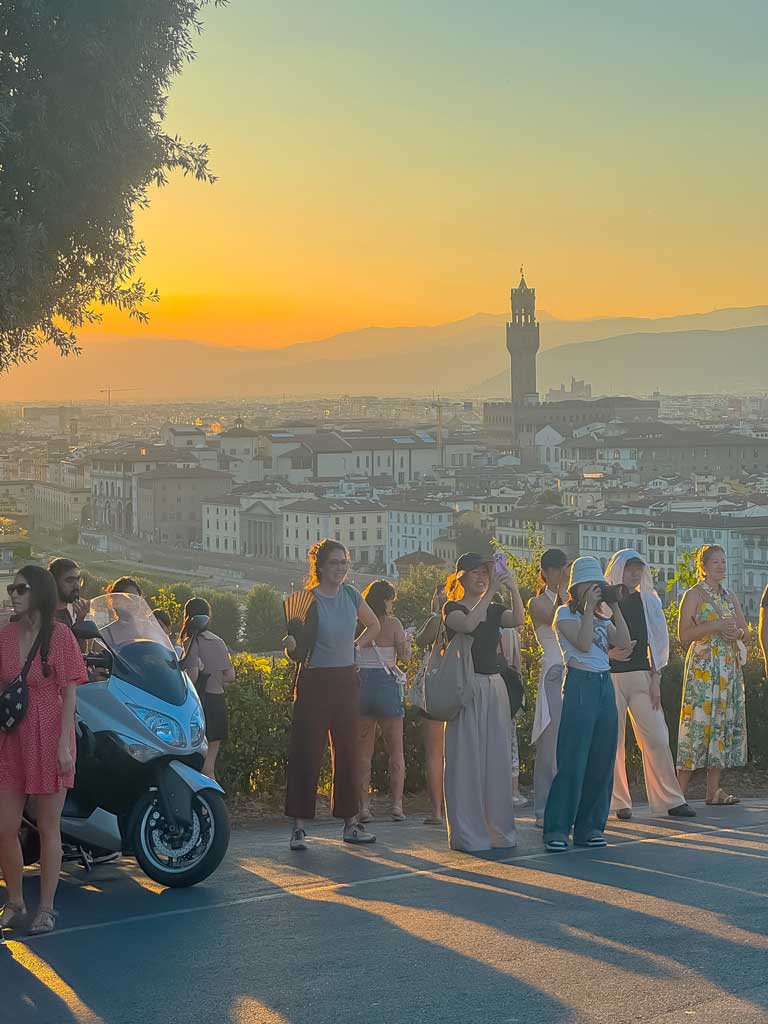
There are four windows. Three of them are quieter than sunset.
Sunset. The light is genuinely extraordinary. The crowd is genuinely large. Sunset times in Florence range from around 16:40 in December to 21:00 in late June. Check the time for your date and arrive 45 minutes earlier. The best position is the northeast corner, on the side closest to the Duomo, not the central railing where the crowd packs in to face the sun. Stay after the sun goes down. The light five to ten minutes after sunset, when the city switches its lamps on and the sky still has colour, is the better photograph.
Sunrise. The light hits the front of the Duomo and the campanile directly. At sunset those buildings are backlit. At sunrise they glow. There are no tour buses, no vendors, almost no people. For photographers, sunrise is the answer almost no guide gives.
Mid-morning to early afternoon. Between 9am and noon the haze has burned off, the crowds are at the Duomo and the Uffizi, and the light on the skyline is clean and frontal. You can move around the terrace freely and take a photo without other people’s phones in the frame.
At night. From May to September the piazzale stays alive after dark. Florentines come up with bottles of wine. Couples sit on the steps. A street musician sets up. People dance. Below the terrace, on the road that descends toward Via del Monte alle Croci, an open-air bar runs from around 7:30pm until 4am with DJ sets and a panoramic terrace. More on that in the drinks section.
How to get to Piazzale Michelangelo: four ways up the hill, ranked
Piazzale Michelangelo is at 104 metres above sea level, on the hill south of the Arno. From the historic centre it is roughly 1.5 km on the map and a vertical climb of about 100 metres. There are four ways up.
Walking up from Ponte Vecchio: the route to take the first time
From Ponte Vecchio, cross to the south bank, turn left along the river, and walk through the San Niccolò neighbourhood — one of the quieter, more residential pockets of central Florence, full of small artisan workshops and wine bars that locals actually use. After about ten minutes you reach Porta San Niccolò, a 14th-century city gate by Arnolfo di Cambio that survived when Florence demolished most of its medieval walls in the 1860s.
From there, two choices. Either follow the road (Viale Giuseppe Poggi) as it switchbacks up the hill, or take the Rampe del Poggi — a sequence of curved stone ramps, fountains, and grottoes that Poggi designed in the 1870s and that were fully restored in 2018. The Rampe is the better choice. Steeper, shorter, prettier.
Total walking time from Ponte Vecchio: 20 to 25 minutes at a normal pace. About 7 of those are the climb itself. It is uphill but it is not difficult. Bring water in summer.
Walking up from Porta Romana: the longer route Florentine joggers use
A different option for visitors staying near Boboli or anyone who wants the climb to be the experience. Walk out through Porta Romana and follow Viale Machiavelli, which curves up through Viale Galileo and arrives at the piazzale from the south. Roughly 3 km, almost entirely uphill, shaded by plane trees most of the way. Allow 45 to 50 minutes. Too much on a hot day. Lovely on a cool spring or autumn morning.
Bus 12 or 13: the right answer when the climb is too much
The Florence city bus system is run by Autolinee Toscane. A standard urban ticket costs €1.70 and is valid for 90 minutes from the moment you validate it. You can also tap a contactless card directly at the reader on the bus.
Two lines stop at Piazzale Michelangelo. Bus 12 runs from Santa Maria Novella station over Ponte alla Carraia, through Oltrarno, and up to the piazzale. Bus 13 runs roughly the opposite direction, over Ponte San Niccolò on the way up. Both take 25 to 30 minutes from the centre depending on traffic.
The bus makes sense if it is raining, if it is August at 35 degrees, if you have mobility issues, if you are with small children, or if you are already exhausted from a full day. For a fit adult on a normal day, walking up is faster than the bus, gives you San Niccolò and the Rampe along the way, and saves you the wait at the stop.
The play locals use: bus up, walk down. You arrive without sweating. You descend with the city in front of you the entire way.
Taxi or rental car: when it is worth it and where to park
A taxi from Ponte Vecchio to Piazzale Michelangelo runs about €12–15 depending on traffic. Ten to fifteen minutes. For a group of three or four splitting the fare, it is competitive with four bus tickets.
Driving works. Piazzale Michelangelo is outside the ZTL (the limited traffic zone that fines unauthorised cars in central Florence), so you do not need a permit to reach it. There are roughly 70 paid parking spaces directly on the square — €1 for the first hour, €2 per hour after that, every day from 8am to midnight, including holidays.
The catch: those 70 spots fill up before sunset. By 17:00 on any summer evening you are circling. Backup parking exists along Viale Giuseppe Poggi and on Via delle Porte Sante (the road up to San Miniato), but read the signs carefully — fines are real and Florence does enforce them.
For most visitors, driving is the wrong answer. Florence has no metro, the parking is tight, and you have come to a city where everything central is walkable. If you are already driving in Tuscany, sure, park here on the way in or out — it is one of the easier places in central Florence to leave a car.
The bronze David in Piazzale Michelangelo is not the real one, and three other things to know about the square itself
The centrepiece is a bronze copy of Michelangelo’s David, raised on a tall pedestal facing the city. Below David, four smaller bronzes reproduce the four allegorical figures — Day, Night, Dawn, Dusk — that Michelangelo carved for the Medici Chapel at San Lorenzo.
The originals of all five are elsewhere. The marble David is in the Galleria dell’Accademia. The Medici allegories are still in the Sagrestia Nuova at San Lorenzo. Everything in the square is a bronze cast, transported up the hill in 1873 with the help of nine pairs of oxen. Beautifully done, but not the real thing. If you came specifically to see Michelangelo’s actual David, this is not where it is. Our honest local’s list of what to see in Florence covers where the originals are.
Behind the terrace stands the neoclassical loggia Poggi designed. On the wall under the loggia, an inscription in Latin commemorates the architect: Giuseppe Poggi architetto fiorentino volgetevi ecco il suo monument — “Giuseppe Poggi, Florentine architect, turn around, here is his monument.” Most people miss it because they are looking the other way.
What else is on the square: souvenir stalls, the kiosks selling drinks and snacks, a few benches, a couple of restaurants behind the loggia. That is the inventory. The view is the attraction. Everything else is supporting cast.
The kiosk-bar tucked under Piazzale Michelangelo that almost no tourist finds
This is the section that does not appear in the standard guides, and it is the one that decides whether your evening on the piazzale is good or great.
There are four ways to drink with a view of Florence here. They are wildly different in price, atmosphere, and what you get.
The drink kiosks on the square. Several stalls on the piazzale itself sell water, soft drinks, beer, prosecco by the plastic glass, and basic snacks. A bottle of water is around €2. A beer or a glass of prosecco is €4–5. There is also a small permanent bar at the intersection with Viale Poggi, with a few tables. The cheapest option, the most informal, and entirely fine. If you brought your own cheese and bread from a market and you just want a drink with the sunset, this is what you use.
Vip’s Bar. Just below the northwest corner of the piazzale, tucked into the wall on Viale Giuseppe Poggi, is a small bar with an outdoor terrace. The menu is short — coffee, gelato, beer, wine, simple cocktails, basic sandwiches. Prices are higher than a neighbourhood bar in town but lower than the formal restaurants on the piazzale. The terrace sits one level below the main square, which means you get the same panorama without the souvenir-stall foreground and without elbowing for a railing position. Most tourists walk straight past it on their way up the steps and never notice it exists. The right place for an aperitivo at golden hour if you do not want to drink from a plastic cup but also do not want to spend €30 a head. Address: Viale Giuseppe Poggi 21.
Flò Lounge Bar. A short walk below the piazzale, off Via del Monte alle Croci, is an open-air bar and club that operates from late spring through to late September. It opens at 7:30pm and runs until 4am. Outdoor terraces built into the hillside, low tables, sofas, a long bar, and a DJ booth that plays from around 10pm onwards. The crowd is mixed — Florentines in their twenties and thirties, occasional tourists who found the place by accident, a stricter dress code on busier nights. There is no real dance floor. People dance where they are standing, on the terraces, with the city lights behind them. Drinks are around €10–15. Arrive before 9:30pm to walk in without queuing. This is the part of Piazzale Michelangelo that most travel content misses entirely. There is a club below the most famous viewpoint in Florence, with Florentines dancing under the stars, and almost nobody writes about it because it does not fit the postcard.
La Loggia. The grand loggia behind the terrace has been a restaurant since 1876. Classic Tuscan food — bistecca, ribollita, pappa al pomodoro — at the prices you would expect for a sit-down restaurant with the best view in Florence. A full dinner runs €60–80 a head with wine. If you want a proper restaurant experience with the view, this is the option. It is not the place to eat if you want honest neighbourhood food at fair prices. For that, walk back down to San Niccolò after sunset and find a trattoria there.
The viewpoint above Piazzale Michelangelo that is higher, free, and almost empty
This is the single most useful thing in this post.
Eight minutes uphill from Piazzale Michelangelo, on the highest point of the same hill, stands the Basilica di San Miniato al Monte — one of the oldest and most beautiful Romanesque churches in Italy, built starting in 1018, with a green-and-white marble facade and 11th-century mosaics that have survived a thousand years of weather, war, and earthquakes.
The view from the front of San Miniato is higher than Piazzale Michelangelo, the framing is cleaner (no souvenir stalls in the foreground), and there are vastly fewer people. From the cemetery beside the church — the Cimitero delle Porte Sante, where Carlo Lorenzini, the author of Pinocchio, is buried — you get another angle on Florence with cypress trees and old chapels in the foreground.
The church is free. It is open daily, with a midday closure (roughly 9:30am–1pm, then 3pm–7pm; Sunday afternoon hours start at 3pm). The Benedictine monks who still live there sing Gregorian chant during vespers, usually around 5:30pm depending on the season. The chant in that interior, with the gold mosaic of Christ above the altar catching the late light, is one of the genuinely unforgettable experiences in Florence.
To reach it from the piazzale: walk to the back of the loggia, take the steep staircase that goes up behind it, and follow Via delle Porte Sante to the church entrance. Eight minutes, mostly stairs.
If you are going to make the climb to Piazzale Michelangelo at all, keep climbing. This is one of the spots covered in the Florence you missed the first time, and it deserves more visitors than it gets.
What is worth visiting near Piazzale Michelangelo: the Rose Garden, the iris bloom, and the wisteria tunnel
Three places on the same hill, all within walking distance, all worth knowing about.
Rose Garden (Giardino delle Rose). Directly below the piazzale on its western side, accessible by a gate just before the main staircase. Over 350 varieties of roses, ten bronze sculptures by the Belgian artist Jean-Michel Folon, and a small Japanese garden in one corner. Free, open year-round, with seasonal hours (roughly 9am–8pm in summer, shorter in winter). In May and June, when the roses are in full bloom, it is one of the prettiest places in Florence. Same view of the city as the piazzale, from a slightly lower angle and with almost nobody in it. If the main square is too crowded at sunset, walk down to the Rose Garden and use it as your viewpoint.
Iris Garden (Giardino dell’Iris). On the eastern side of the piazzale, beside the road that climbs to San Miniato, is a smaller garden dedicated to the iris — the flower on the official symbol of Florence. The catch is that it is only open for about three weeks each year, usually from late April to late May, during the iris bloom. If you happen to be in Florence during those weeks, it is worth the detour. Outside the bloom season the gate is locked.
Bardini Gardens (Giardino Bardini). A 15-minute walk back down toward the river, off Costa San Giorgio, are terraced Renaissance and Baroque gardens with a long staircase, fountains, statues, and a famous wisteria pergola that turns purple for about three weeks in late April and early May. The gardens charge a small entry fee and are far less crowded than the more famous Boboli Gardens next door. The view from the upper terrace at Bardini is one of the quieter alternatives to Piazzale Michelangelo, and the wisteria tunnel during its short bloom is one of the most photographed scenes in the city. If you are spending 48 hours in Florence, it is worth working into the itinerary.
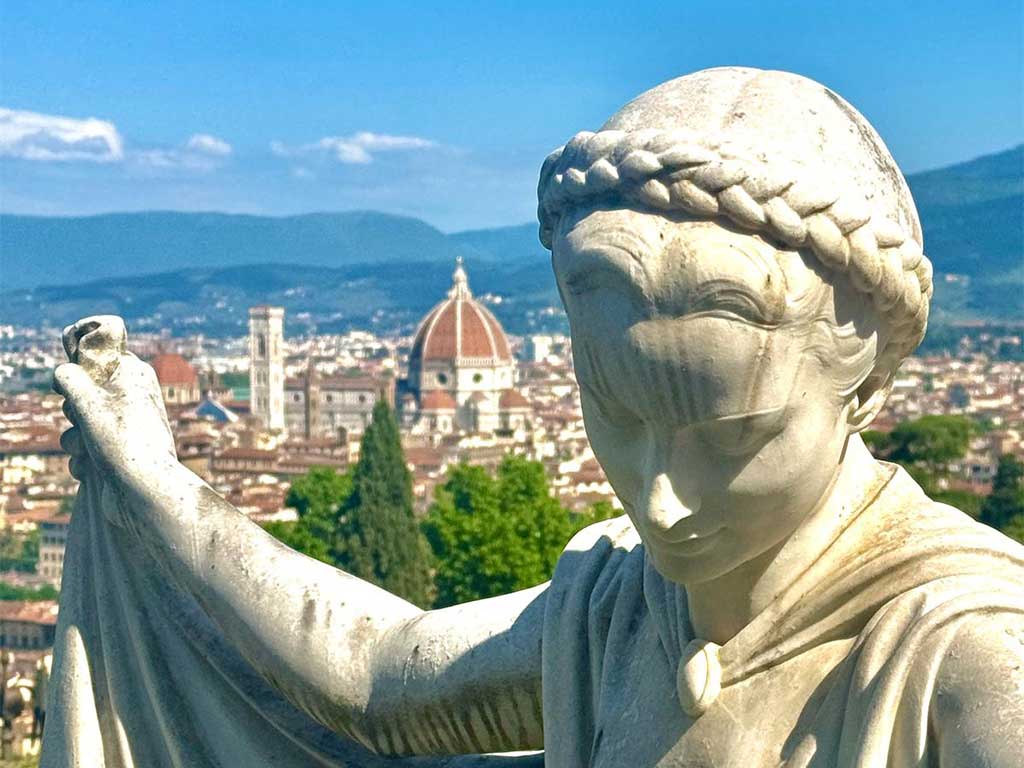
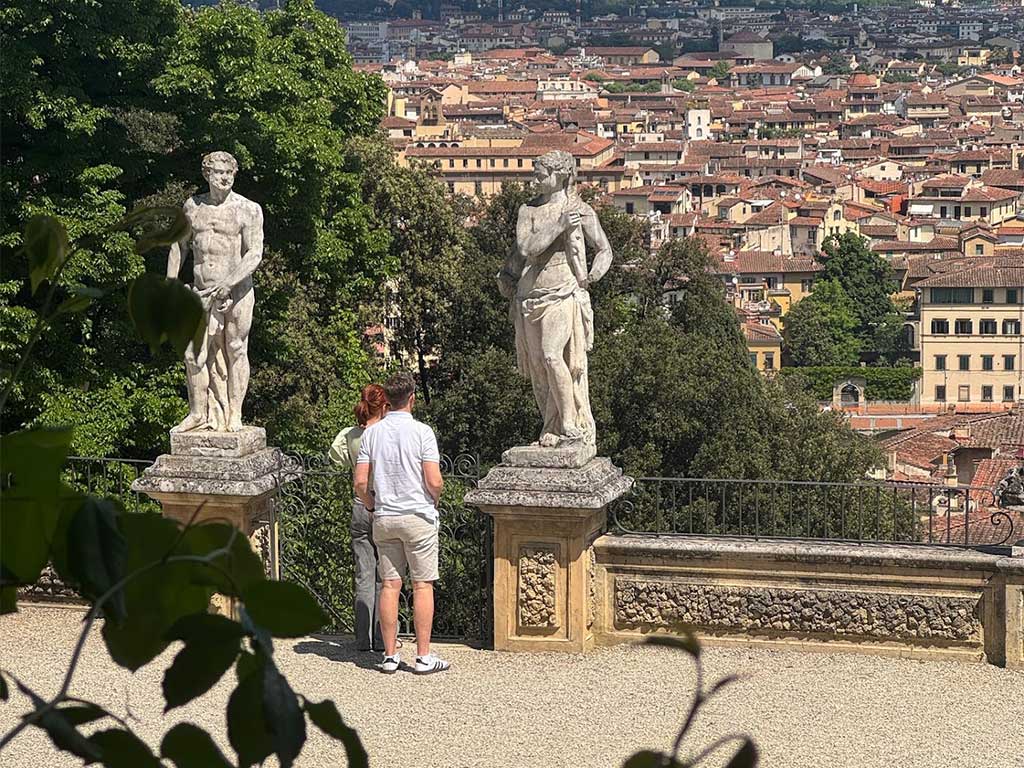
Porta San Niccolò. On the way up or down, you pass through Porta San Niccolò, the 14th-century city gate at the foot of the hill. One of the few medieval towers in Florence that was not demolished during the 1860s urban renewal — it survived because it offered a beautiful view, which is the same reason you are climbing past it now. The tower is occasionally open to the public during summer with guided climbs to the top (160 steps).
What to bring to Piazzale Michelangelo, what to skip, and what it actually costs
Free to enter. No ticket, no booking, no queue.
Bring water, especially in summer. The walk up is more demanding than tourists expect, and the prices for a bottle of water on the piazzale are about double what you would pay at a supermarket.
Bring a layer if you are going for sunset. Florence cools fast after dark, even in August, and the hill is breezier than the city below.
Bring a light dinner if you want a picnic at sunset — bread, cheese, prosciutto, fruit, a bottle of wine — bought from any alimentari or supermarket on your way up. This is what locals do. €15–20 for two people instead of €60+ at the restaurants on the piazzale, and the view is the same.
Public toilets are located up Viale Galileo toward San Miniato. Use is €1. As with most Italian public toilets, bring tissues.
What to skip: the souvenir stalls (the leather is not real, the bags are not authentic, and you can find better quality and better prices in central Florence) and the formal restaurants behind the loggia unless you specifically want a sit-down dinner with the view.
Total cost of a perfect Piazzale Michelangelo visit: zero euros for the view, €5 for a drink at Vip’s or a kiosk, €15 for a picnic, €1.70 each way if you take the bus. Under €25 for two people for one of the best evenings in Florence.
The view from Piazzale Michelangelo is exactly as good as the photographs you have seen. The visit is what you make of it. Go in the morning if you want it quiet and the Duomo lit. Go at sunset if you want the show, and arrive early enough to claim the northeast corner. Stay after dark for the side of the piazzale that the daytime visitors never see. And if you have come this far, keep climbing eight more minutes to San Miniato — that is where the experience tips from “I saw the view” into “I will remember this.”
For the wider context — when to come, where to stay, what else to do in the city — our Florence travel guide for 2026 covers the rest.