Every list you have ever seen about the top things to do at Lake Como starts the same way. Bellagio. Villa del Balbianello. George Clooney’s house. A boat tour. An aperitivo somewhere with a view.
I am from Italy. I have been coming to this lake my whole life. And I can tell you that the places on those lists are not where you go when you actually know the lake. They are where you go when you do not.
The real Lake Como is not in Bellagio on a Saturday in July. It is on a path above Varenna where you are looking down at the water and there is nobody around you. It is in a trattoria in the hills where the menu is written on a blackboard and nobody outside the village knows the name of it. It is in a ghost town near Lecco that was supposed to become the Italian Las Vegas and never did. It is in places that do not have a queue outside them, do not appear on travel blogs, and do not charge you twenty euros for a spritz.
This is my list. Not the usual one.
Nobody on this list has a gift shop. None of them appear on the first page of Google. Some of them do not have a sign outside. These are the places I come back to.
01 The Greenway del Lago di Como: the most beautiful free walk on the lake
On the western shore there is an 11 kilometre walking path called the Greenway del Lago di Como. It follows the ancient Via Regina — a road built by the Romans to connect Como to the territories north of the Alps. It passes through seven villages, past hidden villas, centuries-old churches, olive groves, and lake views that no boat tour can match. It costs nothing.
The route runs from Colonno in the south to Griante in the north, through Sala Comacina, Ossuccio, Lenno, Mezzegra and Tremezzo. Around 11 kilometres total. Three to four hours walking, or a full day if you stop properly. Easy to moderate — some uphill sections, some flat lakeside stretches, comfortable shoes not hiking boots. The path is marked with blue and yellow signs the entire way.
What you actually walk through: in the first stretch the path runs along the old Roman road halfway up the hillside through olive groves and terraced plots with wide open views across the lake. From Sala Comacina you see Isola Comacina — the only island on the lake — from above. In Ossuccio there is a church dating back to the 10th century and a detour to a UNESCO sanctuary with 14 Baroque chapels lining the path that almost no tourist has ever seen. In Lenno the path drops back to the lakeside — public beach, small harbour, a gelateria by the water. From there a one-kilometre side path leads to Villa del Balbianello, the villa used in Star Wars and Casino Royale. The final stretch into Griante runs along the waterfront with Bellagio across the water the entire way.
Walk from Colonno north to Griante. The best views are ahead of you the whole time and you end at the Cadenabbia ferry dock where you can catch a boat across to Bellagio or Varenna, or the C10 bus back to Como.
Getting there: train from Milan to Como in 40 to 60 minutes, then the C10 bus to Colonno in another 40 minutes. A day bus ticket costs around €11.50 and covers unlimited travel on the route. The C10 runs roughly once an hour — check the schedule before you start walking. Missing the last bus means an expensive taxi.
Do not try to do the Greenway and Bellagio and Varenna in the same day. The Greenway alone deserves a full day. Stop in the villages. Eat lunch in Lenno. This is not a race and the people who treat it like one leave wishing they had slowed down.
02 — Walk the Sentiero del Viandante above the eastern shore
The pilgrim’s path runs along the eastern shore from Lecco to Colico at the northern tip of the lake. For centuries, before roads were built, this was the only way to travel the length of the lake. Today it has been completely restored and you can walk it in sections of one to four hours, starting and ending in the main villages.
From Varenna you can walk north to Bellano or up to Vezio Castle. The views from the path are unlike anything you see from the water or the road — you are above the lake, in the mountains, looking down across the full width of it. Most visitors to Lake Como never find it. Go on a weekday morning and you will have long stretches entirely to yourself.
03 The Bellano Orrido: the natural gorge one stop from Varenna
Bellano is one train stop north of Varenna. The Orrido is a narrow gorge carved by the Pioverna river through solid mountain rock over centuries. A suspended walkway runs a few metres above fast-moving turquoise water. It takes thirty minutes. It costs very little.
It is one of the most genuinely surprising thirty minutes on the entire lake and almost no travel guide covers it the way it deserves. After Bellagio and its souvenir shops, Bellano hits completely differently — locals actually live there, the restaurants have no English menu outside, and the Orrido makes you feel like you have found something rather than being shown something.
04 Consonno: the abandoned Italian Las Vegas near Lecco
In the 1960s a developer tore down a medieval village near Lecco and built an amusement park designed to become the Italian Las Vegas. Nightclubs. A hotel. A minaret tower rising from the hills above the lake. Then a landslide in 1976 cut the only road in and the entire project collapsed overnight.
The buildings were abandoned. The forest moved back in. Today Consonno is one of the strangest and most beautiful places in northern Italy — a ghost town slowly being reclaimed by nature, watched over by a group of local elders who organise a chestnut festival there every autumn. The minaret is the most photographed structure but exploring the rest of the site is the real experience. Go carefully — the buildings are unstable.
05 Corenno Plinio: the walled hamlet almost nobody visits
At the northern end of the eastern shore, Corenno Plinio is a tiny medieval hamlet behind a paid entrance, known locally as the hamlet of a thousand steps. Every August a full medieval reenactment takes place — fire-breathers, jesters, archery, knights. The rest of the year it is one of the quietest and most photogenic places on the lake. English-language travel guides do not mention it. The website is corenno.it for dates and tickets.
06 Isola Comacina: the only island on the lake
Near Ossuccio on the western shore, Isola Comacina is the only island in the lake. Small, quiet, covered in ancient ruins from the Roman period and the early Middle Ages. A single guardian lives there. Guided tours run from the shore near Ossuccio. The island was inhabited and then abandoned and the ruins were left exactly where they fell. It is not dramatic. It is the kind of place that stays with you for reasons you cannot entirely explain. Almost nothing in the tourist literature covers it properly. That is the reason to go.
07 Piona Abbey on the Olgiasca peninsula
At the northern end of the lake, the Cistercian Abbey of Piona has stood since the 7th century on the small Olgiasca peninsula. Still inhabited by monks. The medieval church of San Nicola and the cloisters are intact and open to visitors. No coach tours. No ticket booths with queues. Just a very old building at the edge of the water that has been there since before most of Europe’s cities existed.
08 San Tomaso above Lecco: where locals actually go on weekends
Thirty minutes of walking from the valley floor brings you to a wide green plateau above Lecco with an open view of the lake and a mountain refuge serving traditional food — polenta, local cheese, honest wine at prices that have nothing to do with the tourist economy on the shore below. This is not a tourist destination. It is where the people who live here go on Sunday mornings when the weather is good. Avoid Sundays for exactly that reason — go on a weekday and you will have the plateau almost entirely to yourself.
09 Vezio Castle above Varenna
Fifteen minutes of steep walking above Varenna, the castle sits on a hill with better views of the lake than anywhere in the village below. Life-size plaster sculptures are positioned throughout the ruins — strange figures that look like dementors, replaced every year. Medieval reenactments with archery and knights run on four days each summer. The walk up is hard enough to deter most of the Varenna day-trippers, which means the castle is genuinely quiet when the village below is overwhelmed. Go in the morning before the heat builds.
10 Villa Carlotta in Tremezzina: the garden that earns its price
Of all the villas on the lake, Villa Carlotta has the best garden. Visit in April or May when the azaleas and rhododendrons are in bloom — the colours against the lake and the mountains are unrepeatable and the photographs do not do it justice. The villa itself contains an art museum with a Canova sculpture worth seeing. Less crowded than Villa del Balbianello and no advance booking needed for most of the year. If you see one villa on Lake Como, this is the one.
11 Aperitivo at 6pm: the most local thing you can do on this lake
At around 6pm, stop at any local bar that is not on the main tourist street and order an aperitivo. For €8 to €12 you get a drink — Campari, Aperol, a glass of local wine — and a spread of food. This is not a tourist product. It is how people who live here end every working day. On a terrace above the water in the evening light, watching the day-trippers leave and the lake go quiet, it is one of the most genuinely Italian experiences the lake offers. And almost nobody visiting does it, because they have already gone back to their hotel by the time it starts.
What to eat: the dishes that actually belong to this lake
Every Italian region has its own food and Lake Como is no different. The problem is that the tourist restaurants on the lakeside serve pasta and pizza because that is what visitors expect. The food that belongs to this lake is almost never on those menus.
Risotto al pesce persico — perch risotto — is the dish. If you eat one thing here, eat this. Fresh perch from the lake, cooked into risotto the way it has been done here for generations. Find it in a trattoria in the hills, not on the lakeside.
Missoltino — sun-dried shad, salted and pressed, served with polenta. Fritto di alborelle — deep-fried lake fish, small and crisp. Agone in carpione — marinated shad. These are the lake dishes. They exist in the older, quieter restaurants away from the water. Ask for them by name.
For pizzoccheri — buckwheat pasta with cheese, butter and vegetables from the nearby Valtellina valley — go to Chalet Gabriele in Esino Lario above Bellagio. It is the best version on the lake. The dish was invented in Teglio, north of the lake, and that is where you go for the original.
Best gelato by specific name: La Fabbrica del Gelato in Menaggio and Lenno. Il Gelataio Matto in Bellano. Capo Horn in Lecco. These are the names locals give when asked. Anything in the centre of Bellagio or Varenna on the main tourist street is priced for visitors and made accordingly.
Best Neapolitan pizza: O’ Garibaldin in Gravedona on the upper lake. Worth the drive.
The one rule that applies to everything on this list
The general rule is the same as everywhere in Italy and applies harder here because the tourist pressure is so concentrated. Any restaurant on the lakeside with an English menu and photographs of the dishes is cooking for first-time visitors who will never come back. Walk away from the water. Find a street with locals in it. Look for the word osteria or trattoria above the door. The food will be better. The prices will be honest. And you will be eating in the same place that the people who live here eat — which is the only measure of a restaurant that actually matters.
The ferry system: the one thing you need to understand
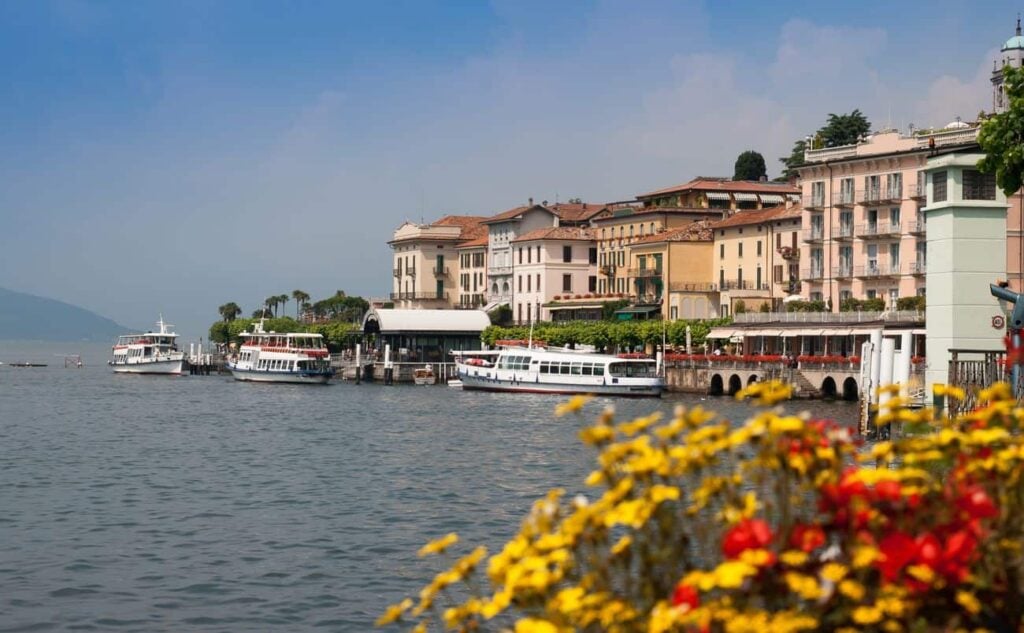
Every village on the lake is connected by ferry. Buy a day pass — €15 to €23 depending on the zone — first thing in the morning. It gives you unlimited travel all day and pays for itself on the second journey. Most tourists do not know it exists and spend three times as much buying single tickets.
Take the regular boat, not the hydrofoil. The hydrofoil is faster but you sit inside looking through small windows. The boat is slower and the view is the whole point. Car ferries connect Varenna, Menaggio, Bellagio and Cadenabbia if you are crossing with luggage or a vehicle.
The single most important thing to know about the ferries: timing. From 10am every day in summer, day-trippers from Milan flood into Varenna and Como and all head to Bellagio at the same time. The Varenna ferry dock between 10am and 3pm means two-hour queues on Sundays. Bellagio at midday means 40,000 people in a village built for 4,000. From 1pm the same crowd tries to leave all at once.
Before 9am the lake is quiet and exactly as beautiful as the photographs. After 5pm the day-trippers are gone and the villages go back to themselves. These are the two windows when Lake Como is actually worth being at. Plan around them and the ferry system works perfectly. Ignore them and the lake will disappoint you.
If you want to go deeper on how the ferry system works, the timing, the tickets, and how to avoid the chaos entirely — the full Lake Como ferry guide covers everything.