Walk the main street of Sperlonga’s old town in August and you will pass twenty-five shops. Most of them sell the same things. Printed tea towels, ceramic magnets with the name of the town across them, bottles of olive oil with a generic Mediterranean label, straw hats made in a factory somewhere you will never visit — most of shopping in Sperlonga, if you walk the obvious route, is the same merchandise you find in every coastal town from Tropea to Taormina.
There is nothing wrong with any of this if that is what you want. But if you have travelled to a town of three thousand people on a rock above the Tyrrhenian and you want to take home something that was actually made there, the honest number of shops worth your time is four.
This is the list. Addresses, what to buy, and why each one is different from the ones next door. If you want the rest of the town — what to eat, where to park, how many days you need — the full Sperlonga travel guide covers it.
The honest starting point: most of what’s sold in Sperlonga’s old town is not made in Sperlonga
A lot of what you see on the main drag is imported, mass-produced, or both. The ceramic plates with “Sperlonga” hand-painted across the middle are mostly made elsewhere. The leather sandals with the little seashell buckles are mostly made elsewhere. The straw bags hanging in the doorways are mostly made elsewhere.
This is not a scandal. It is how most seaside tourist towns in Italy work. But it matters because it changes what the word “shopping” means here. If you think of Sperlonga shopping as “browse whatever is in the window,” you will come home with a bag of things that could have been bought in any coastal town from Tropea to Taormina.
If you think of it as “find the four shops where the person behind the counter either made what they are selling or picked it personally,” the trip becomes worth the walk.
Here they are.
Acqua di Sperlonga Boutique: the fragrance shop where the scent actually lasts
Piazza della Libertà 4, at the top of the old town.
This is a small profumeria, one room, one woman behind the counter. There is no wall of five hundred bottles. There is a selection she has chosen herself, and when you walk in she does not pretend you know what you want. You tell her what you like. She hands you two or three things. You pick one.
What she sells: perfumes, home diffusers, and a small souvenir coffret — a mini-fragrance set that is the thing most people end up carrying home.
The quiet thing about Sperlonga-scent souvenirs is that most of what you buy in a seaside town fades by the time you unpack. These do not. You spray one on in London or Milan in November and you are back on the piazza.
One practical note: hours are irregular. It is the kind of shop that opens when the owner is there and closes when she is not. In July and August this is rarely a problem. Off-season, call before you walk over: 0771 548239.
What to buy: the diffuser for the house, the coffret for someone you love, or the one bottle she picks for you. Skip anything you already own a cheaper version of.
Emanuela Battista Creazioni d’Arte: ceramics made by the woman behind the counter
In the old town, up in the narrow streets.
You find this shop by getting slightly lost. That is the correct way to find it. White walls, a small space, ceramics in colours that do not match the ones in the window next door. Emanuela is there, and she makes what she sells.
What she makes: small ceramic pieces, earrings, home objects. Not tableware sets. Small, specific things you can carry home without worrying about breakage.
The difference between her shop and the six ceramic shops you pass on the way is simple: nothing is repeated. The pieces are one-offs or short runs. She explains, she helps, she does not pressure. People walk in saying “just looking” and walk out with something that was not on any list.
What to buy: a small ceramic object or a pair of earrings. The price point is approachable — this is the shop to buy for the friend who does not want a keyring and does not want an expensive piece, just something real.
D’Anna Calzature: handmade shoes most visitors walk past
In the old town.
Colourful shop, easy to miss if you walk past quickly. Sandals, shoes, leather bags, and small details throughout. The interior has a clear style — simple, elegant, a little playful — and nothing feels randomly selected.
What matters here: the shoes are handmade. Not “Italian design, made somewhere.” Handmade. That is the thing to ask about and the thing that separates this shop from the five others in the old town selling painted leather sandals for twenty-five euros.
The other thing most people don’t expect is that the shoes are actually comfortable. Handmade Italian sandals have a reputation for being beautiful and punishing. These are made to wear on the beach road and the cobbles, not just to photograph.
What to buy: a pair of sandals you will actually wear in the summer back home, or a small leather bag. Skip anything that looks like it exists in every other shop.
Artigianstrame Casalé: five generations of straw weaving in Piazza della Rimembranza
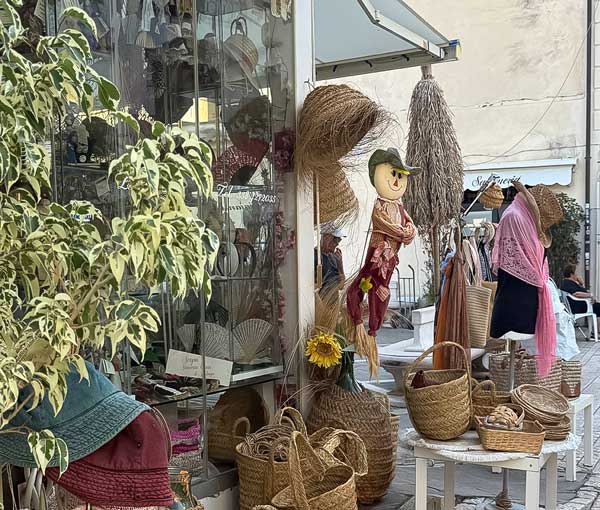
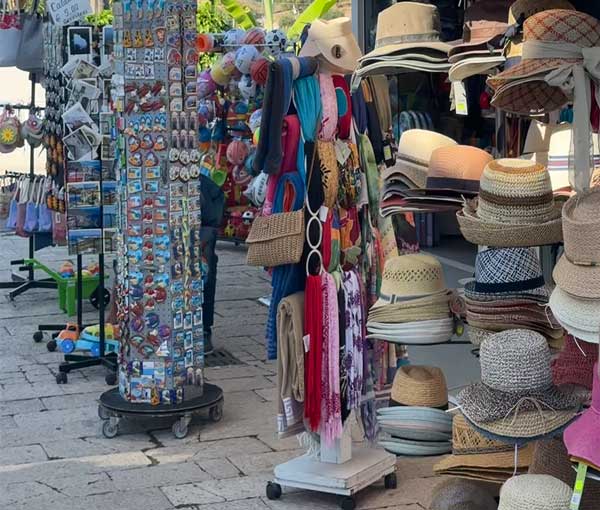
Piazza della Rimembranza.
This is the oldest shopping stop in the old town, and it is the most specific. Artigianstrame Casalé has been weaving straw in Sperlonga for five generations. Hats, bags, baskets, traditional pieces you do not see in the factory-produced imitations next door.
The difference is visible the moment you pick something up. Factory straw is uniform, dyed evenly, and light. Hand-woven straw is denser, irregular in the best way, and has the smell of the material still on it. A hand-woven beach hat lasts ten summers. A factory straw hat lasts until the first rainstorm.
Someone in the shop will tell you how to take care of what you buy so it lasts. Take that conversation seriously — the difference between a hat that holds its shape for a decade and one that collapses in a year is mostly in how you store it.
What to buy: a sun hat for the beach, a straw market basket, or a small woven bag. These are the objects worth the space in your suitcase.
The Friday market: the one day of the week when Sperlonga shops the way locals shop
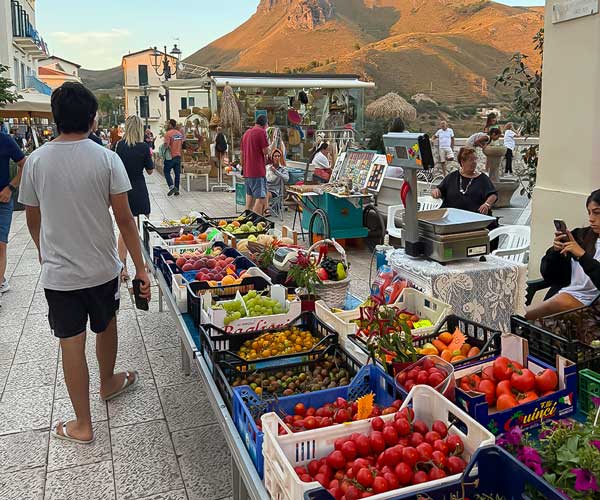
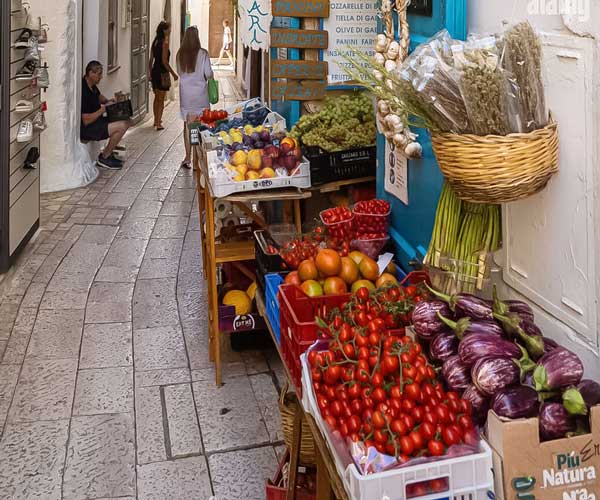
Every Friday morning, Sperlonga’s weekly market sets up outside the old town walls. This is where the town actually shops — not for souvenirs, for food.
You will find everything this coastline is known for. Buffalo mozzarella from the dairies across the border in Campania, so fresh it arrives that morning. Tiella di Gaeta — the stuffed flatbread from the next town south, delivered fresh and eaten warm, filled with escarole and olives, octopus, or tomato and anchovy. Gaeta olives, small and black and nothing like the supermarket version. Local olive oil, local honey, seasonal fruit from the hills behind the coast, Ventotene lentils from the island offshore, fresh fish from the morning boats.
Pick what looks good. The quality is uniformly high — this is not a tourist market, it is a working one, and vendors who sell bad food at a Friday market in a town of three thousand people do not survive the season.
If you are driving home or to your next stop, the market is where to stock up for the road. A block of mozzarella, a jar of olives, a piece of tiella wrapped in paper, and you have lunch for the next three hundred kilometres. If you want to know more about the olive DOP and the traditions that made this coastline famous, the Gaeta guide covers them properly.
One practical note: bring cash. Some vendors take cards now, many do not.
What to bring home that isn’t a fridge magnet
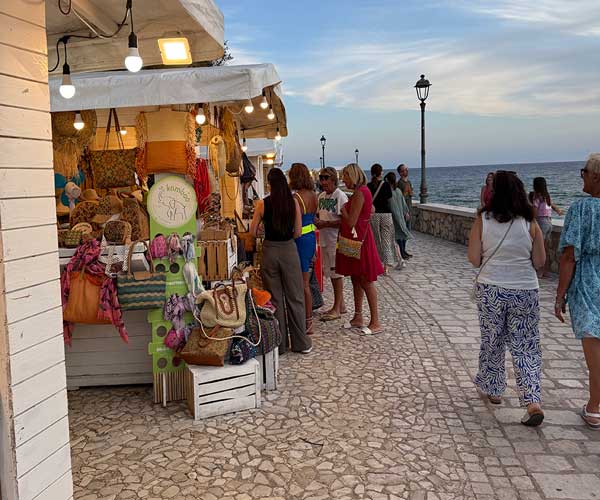
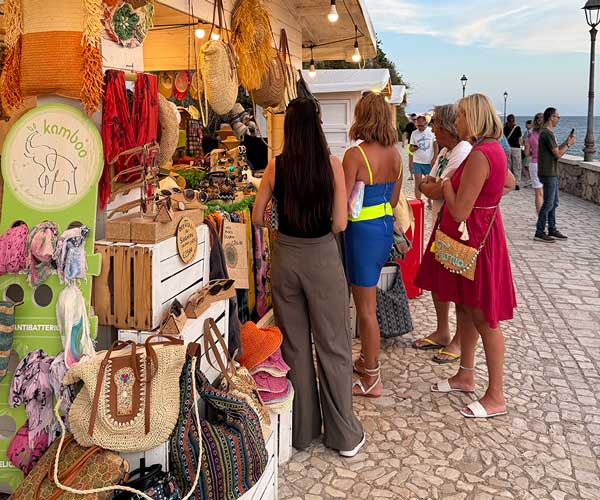
If you want a short list of the things worth the suitcase space, here it is.
A hand-woven straw bag or hat from Artigianstrame Casalé. A ceramic object from Emanuela’s shop. A small fragrance or diffuser from Acqua di Sperlonga. A pair of handmade sandals from D’Anna. From the Friday market: a jar of Gaeta olives, a bottle of local olive oil, and — if you are driving and have a cooler — a block of mozzarella di bufala eaten within twenty-four hours of leaving the stall.
That is it. Four shops and one morning at the market. Everything else in the old town is the same merchandise you can buy in any seaside town in Italy, for roughly the same price, wrapped in a slightly different bag.
One trip, a small bag of things that are actually from here, and you have done Sperlonga shopping honestly. For context on how much time to give all of this — and whether shopping earns half a day of your itinerary or two hours — how many days you actually need in Sperlonga lays it out.
Practical notes: hours, payment, and why Sundays are quiet
Opening hours in the old town are Italian seaside hours. Most shops open around ten in the morning, close for lunch from roughly 1pm to 4pm, and reopen in the late afternoon until 8pm or later in summer. In July and August the afternoon closure is shorter or skipped entirely. In October and the shoulder seasons, the afternoon reopening can be late or not happen at all.
Sundays are quieter. Some shops open, many do not, and the ones that do often run shorter hours. If a specific shop matters to your trip, the safest day to visit is any weekday morning.
Cards are accepted in most shops now, but the market runs largely on cash. Bring some. The nearest ATM is in the lower town near the beach, not in the old town — plan accordingly.
For bus timetables, parking, bathrooms and everything else that makes a Sperlonga trip run smoothly, the Sperlonga practical tips post covers them.
Shop small, shop specific, and walk past anything that looks like it belongs in an airport.